.
More than 14,000 participants have signed up. The course will officially start on May 19, 2014. It is part of the European Journalism Centre’s Data Driven Journalism initiative, which aims to enable more journalists, editors, news developers and designers to make better use of data and incorporate it further into their work. Started in 2010, the initiative provides resources for journalists through DataDrivenJournalism.net, the School of Data Journalism, and the Data Journalism Handbook.
Participants in the new online course will learn the essential concepts and skills to work effectively with data and produce compelling stories under tight deadlines. The line-up of instructors and advisors hails from journalism schools and media outlets around the world. Listen to them introduce themselves below - and enroll in the course.
Tampilkan postingan dengan label Power of Data. Tampilkan semua postingan
Tampilkan postingan dengan label Power of Data. Tampilkan semua postingan
Jumat, 28 Maret 2014
Launching a MOOC for data journalism
Mass open online education courses - MOOCS - are transforming education. We’re working with the European Journalism Centre to bring journalism education online, offering a free web data journalism course ‘Doing Journalism with Data: First Steps, Skills and Tools.’

Jumat, 14 Maret 2014
Driving data-driven innovation at CeBIT
CeBIT is the worlds biggest IT-fair, attracting world leaders to make an annual pilgrimage to the Hannover Fair Grounds. This year, UK Prime Minister David Cameron joined German Chancellor Angela Merkel for the opening event. We came to advance the agenda of Data-Driven innovation.

In Germany, data all too often often is seen in a negative light. We believe it can be, properly used, a powerful motor for economic and social progress. We Accenture and Acatech that produced a report on Data-Driven Innovation, which was handed over during the fair to Chancellor Merkel. German corporate heavyweights including Deutsche Bahn, Deutsche Post, Siemens, Miele, Deutsche Telekom, SAP, and Thyssen-Krupp participated as well. The report’s conclusion was clear: Germany needs to embrace the value of data to remain competitive.
Data is not just a dry well of numbers. It can be used in exciting, dramatic and artistic ways as well. We partnered with CODE_n to run a DatenDialog in a hall surrounded by 50 start-ups under the topic of “driving the data revolution”. Artists Kram/Weisshaar visualized data from the Ngram viewer on a wall of 80mx20m, showcasing our partnership with the Bavarian State Library to digitise its priceless book collection.

Another priority for us at CeBIT was digital safety and literacy - closing the gap between the comfortable-with-Internet and the left-out less-comfortable-with-Internet. Federal Minister of the Interior Thomas de Maizière visited the booth of our NGO partner Deutschland sicher im Netz and learned about our joint initiative "Digital Neighborhood." It consists of a set of ready-to-use lesson plans for volunteer IT trainers who want to teach computer and Internet basics.
Germany needs to embrace the digital revolution in order to keep its position as one of the world’s economic and exporting powerhouses. In her keynote remarks, Chancellor Merkel acknowledged tremendous “respect” for the IT industry as a source of growth and praised is the emergence of a strong German Start-Up culture. Let’s hope these words soon will extend to praising the merits of data driven innovation.

In Germany, data all too often often is seen in a negative light. We believe it can be, properly used, a powerful motor for economic and social progress. We Accenture and Acatech that produced a report on Data-Driven Innovation, which was handed over during the fair to Chancellor Merkel. German corporate heavyweights including Deutsche Bahn, Deutsche Post, Siemens, Miele, Deutsche Telekom, SAP, and Thyssen-Krupp participated as well. The report’s conclusion was clear: Germany needs to embrace the value of data to remain competitive.
Data is not just a dry well of numbers. It can be used in exciting, dramatic and artistic ways as well. We partnered with CODE_n to run a DatenDialog in a hall surrounded by 50 start-ups under the topic of “driving the data revolution”. Artists Kram/Weisshaar visualized data from the Ngram viewer on a wall of 80mx20m, showcasing our partnership with the Bavarian State Library to digitise its priceless book collection.

Another priority for us at CeBIT was digital safety and literacy - closing the gap between the comfortable-with-Internet and the left-out less-comfortable-with-Internet. Federal Minister of the Interior Thomas de Maizière visited the booth of our NGO partner Deutschland sicher im Netz and learned about our joint initiative "Digital Neighborhood." It consists of a set of ready-to-use lesson plans for volunteer IT trainers who want to teach computer and Internet basics.
Germany needs to embrace the digital revolution in order to keep its position as one of the world’s economic and exporting powerhouses. In her keynote remarks, Chancellor Merkel acknowledged tremendous “respect” for the IT industry as a source of growth and praised is the emergence of a strong German Start-Up culture. Let’s hope these words soon will extend to praising the merits of data driven innovation.
Selasa, 15 Oktober 2013
Injecting data into journalism
We’ve long believed that the vast amounts of information unearthed by the Internet can power innovations in journalism. That’s why we are supporting the European Journalism Centre’s new online data journalism course. Registration for Doing Journalism with Data: First Steps, Skills and Tools has just opened at http://www.datadrivenjournalism.net/course/.
This five-module introductory course will give participants the essential concepts, techniques and skills to effectively work with data to produce compelling and visual stories. It is open to anyone with an Internet connection and is due to start in early 2014.
The course features a stellar line-up of instructors and advisors from the Walter Cronkite School of Journalism, New York Times, ProPublica, Wired, Twitter, La Nacion Argentina, the Chronicle of Higher Education, Zeit Online, and others. “Whether you want to get over your fear of Excel, learn the language of your data geeks, or discover how to tell stories with data visualisations, this course will help journalists and newsrooms learn how to take advantage of these invaluable skills,” said Josh Hatch, senior editor at The Chronicle of Higher Education and member of the course’s Advisory Board
There is already plenty of evidence of the opportunities and insights to be had in data driven journalism. We hope a graduate of this new course will soon be producing similar ground-breaking journalism.
This five-module introductory course will give participants the essential concepts, techniques and skills to effectively work with data to produce compelling and visual stories. It is open to anyone with an Internet connection and is due to start in early 2014.
The course features a stellar line-up of instructors and advisors from the Walter Cronkite School of Journalism, New York Times, ProPublica, Wired, Twitter, La Nacion Argentina, the Chronicle of Higher Education, Zeit Online, and others. “Whether you want to get over your fear of Excel, learn the language of your data geeks, or discover how to tell stories with data visualisations, this course will help journalists and newsrooms learn how to take advantage of these invaluable skills,” said Josh Hatch, senior editor at The Chronicle of Higher Education and member of the course’s Advisory Board
There is already plenty of evidence of the opportunities and insights to be had in data driven journalism. We hope a graduate of this new course will soon be producing similar ground-breaking journalism.
Kamis, 08 Agustus 2013
Searching in Summer
For much of Europe, August is synonymous with holidays and we’ve been trolling through Google Trends’s new Hot Searches tool to see what is amusing, fascinating or titillating Europeans during the summer.
The clear winner - football.
Even before the Premier League kicked off, UK searchers went looking for game scores as lower Championship League swung back into action. Liverpool's Luis Suarez and Manchester United Wayne Rooney’s transfer sagas scored high and Charlotte Green’s appointment as the first woman announcer of the BBC’s Saturday Football topped the ranking of the August 7 Hot Searches.
In Germany, results of the first round of the DFB Cup, particularly Bayern Munich’s crushing 5-0 victory, led the August 6 results. Russians searched for the fortunes of the Anzhi team’s financial issues and St. Petersburg’s Zenit’s purchase of two players, full-back "Rubin" and Argentinian Cristian Ansaldi.
Admittedly, some serious issues received serious attention. When Bavarian judges ordered the immediate release of 57-year old Gustl Mollath, from an institution for the criminally insane, the legal scandal surrounding the case soared to the top of Germany’s searches. Severe storms affecting German train traffic received wide attention, as did Amazon founder Jeff Bezos’s purchase of the Washington Post. Russians searched for news about government’s decision to accept American leaker Edward Snowden’s asylum request and the mass protest against a new Internet anti-piracy law.
Take a look yourself at Google Trends and see for yourself what people, places and issues are making waves.
The clear winner - football.
Even before the Premier League kicked off, UK searchers went looking for game scores as lower Championship League swung back into action. Liverpool's Luis Suarez and Manchester United Wayne Rooney’s transfer sagas scored high and Charlotte Green’s appointment as the first woman announcer of the BBC’s Saturday Football topped the ranking of the August 7 Hot Searches.
In Germany, results of the first round of the DFB Cup, particularly Bayern Munich’s crushing 5-0 victory, led the August 6 results. Russians searched for the fortunes of the Anzhi team’s financial issues and St. Petersburg’s Zenit’s purchase of two players, full-back "Rubin" and Argentinian Cristian Ansaldi.
Admittedly, some serious issues received serious attention. When Bavarian judges ordered the immediate release of 57-year old Gustl Mollath, from an institution for the criminally insane, the legal scandal surrounding the case soared to the top of Germany’s searches. Severe storms affecting German train traffic received wide attention, as did Amazon founder Jeff Bezos’s purchase of the Washington Post. Russians searched for news about government’s decision to accept American leaker Edward Snowden’s asylum request and the mass protest against a new Internet anti-piracy law.
Take a look yourself at Google Trends and see for yourself what people, places and issues are making waves.
Selasa, 23 Juli 2013
Measuring the UK’s Digital Economy
The British mathematician and physicist Lord Kelvin famously said “If you cannot measure it, you cannot improve it.” In 1948, the post-war British Government badly needed to improve the nation’s economy. To help it draw up the right policies for jobs and growth, the Government took a scientific approach - one of which Lord Kelvin would have been proud. Government statisticians were instructed to count, classify and measure the economic activity of every business in the country. They developed a set of Standard Industrial Classification codes and the data they collected was used to shape policy in every aspect of the British economy.
This week, a new report by the National Institute for Economic and Social Research, and supported by Google, updates these SIC codes to include the new, fast growing digital sector. After 65 years, the old codes are out of date. One in ten companies in the UK are now classified vaguely as ‘other’. One in five have no classification at all.
This new report is based on pioneering big data techniques. It draws not just from official tables and accounts but instead is gleaned from more than five billion data points, providing us with a level of detail and insight that statisticians in 1948 could scarcely have imagined.
The scale of the UK’s digital economy that emerges from this research is immense. In June 2013, the Government estimated from SIC codes that there were 120,000 businesses in the digital economy. The most conservative estimate from this new report of the number of digital companies is more than double government estimates - 269,695. In addition, the report found that digital companies employ 15% more, grow 25% faster than non-digital companies.


The digital economy has spread into every part of the United Kingdom, not just in London and the South East but throughout the country, with particularly great intensity in places like Manchester, Middlesbrough and Aberdeen. It has spread into every sector, from architecture firms whose activities have become almost entirely digital to machine tool manufacturers who now use huge online data-processing facilities, such as Hadoop, to monitor every aspect of their processes.
This is a groundbreaking work. For the first time in 65 years - it presents us with a new way of measuring the economy that can only help us to take the right steps to support growth and jobs.
This week, a new report by the National Institute for Economic and Social Research, and supported by Google, updates these SIC codes to include the new, fast growing digital sector. After 65 years, the old codes are out of date. One in ten companies in the UK are now classified vaguely as ‘other’. One in five have no classification at all.
This new report is based on pioneering big data techniques. It draws not just from official tables and accounts but instead is gleaned from more than five billion data points, providing us with a level of detail and insight that statisticians in 1948 could scarcely have imagined.
The scale of the UK’s digital economy that emerges from this research is immense. In June 2013, the Government estimated from SIC codes that there were 120,000 businesses in the digital economy. The most conservative estimate from this new report of the number of digital companies is more than double government estimates - 269,695. In addition, the report found that digital companies employ 15% more, grow 25% faster than non-digital companies.


The digital economy has spread into every part of the United Kingdom, not just in London and the South East but throughout the country, with particularly great intensity in places like Manchester, Middlesbrough and Aberdeen. It has spread into every sector, from architecture firms whose activities have become almost entirely digital to machine tool manufacturers who now use huge online data-processing facilities, such as Hadoop, to monitor every aspect of their processes.
This is a groundbreaking work. For the first time in 65 years - it presents us with a new way of measuring the economy that can only help us to take the right steps to support growth and jobs.
Sabtu, 04 Mei 2013
Data journalism awards shortlist announced
Not long ago, reporters digging through data set to tell stories, probe trends, and even uncover scandals was a novelty. They are now moving into the mainstream - and changing the field of journalism. One sign of this increased popularity comes from the success of the Google-supported Data Journalism Awards.
 This year’s contest received 300 applications from all over the world, about 10 percent more than the previous year. The 73 finalists come from 19 different countries, ranging from Argentina to Venezuela. Major media groups as well as small, regional newspapers and research groups are included. Click here to get a full list of the shortlisted projects.
An independent jury presided over by former Wall Street Journal editor-in-chief and Pro-Publica founder Paul Steiger will award total of EUR15,000 to eight winning projects. For the first time, the public will chose a special “Public Choice Award.” Visit datajournalismawards.org and vote for your avourite data application or visualisation. Take a look below at last year's award ceremonies.
2012 Data Journalism Awards from Global Editors Network on Vimeo.
The winners will be announced during the Global Editors Network News Summit in Paris on June 20 at 6:15pm. All finalists are invited to attend the Data Journalism Awards ceremony.
 This year’s contest received 300 applications from all over the world, about 10 percent more than the previous year. The 73 finalists come from 19 different countries, ranging from Argentina to Venezuela. Major media groups as well as small, regional newspapers and research groups are included. Click here to get a full list of the shortlisted projects.
An independent jury presided over by former Wall Street Journal editor-in-chief and Pro-Publica founder Paul Steiger will award total of EUR15,000 to eight winning projects. For the first time, the public will chose a special “Public Choice Award.” Visit datajournalismawards.org and vote for your avourite data application or visualisation. Take a look below at last year's award ceremonies.
2012 Data Journalism Awards from Global Editors Network on Vimeo.
The winners will be announced during the Global Editors Network News Summit in Paris on June 20 at 6:15pm. All finalists are invited to attend the Data Journalism Awards ceremony.
Senin, 08 April 2013
Celebrating data-driven innovation in Brussels
Update, April 22: Videos of the innovation forum are now available. Take a look on the European Institute of Innovation and Technology Foundation's website or below:
We now create as much information every two days as we did from the dawn of civilization up until 2003. And this rich flow is destined to accelerate. McKinsey projects 40% growth annually in global data generated. To showcase the potential of data for Europe’s economy and society, we recently teamed up with the European Institute of Inovation and Technology Foundation, the Bavarian Representation to the European Union and Euronews.
The forum, Data-Driven Innovation: The New Imperative for Growth, debated how data can improve the delivery of public services, provide accurate healthcare diagnosis, and generate higher business productivity. Androulla Vassiliou, European commissioner for education, culture and multilingualism, and Neelie Kroes, European commissioner in charge of the digital agenda, both called for unleashing a Big Data revolution in Europe. "This is the new frontier of the information age," Vassiliou said. "In the current path to stimulate European growth and jobs, there has never been a more critical time to harness the potential of data."
Senior representatives of the education, research, policy and business communities presented compelling evidence of how data could address big societal challenges. Computer-powered DNA sequencing open the possibility of accelerating medical diagnoses. Online college courses could revolutionize education. Google's own Vice President for Research Alfred Spector showed how we use data for products such as Google Translate.
Data also is powering entrepreneurs. New online business models make sense out of data include social media power startups such as news organiser Storify. Its founder Xavier Damman explained how established organisations and top politicians such as BBC, the White House or UK Prime Minister David Cameron use his company’s services to share knowledge from different online data sources, including Twitter, Google+, and traditional media websites.
The concluding panel looked at the ethical aspects of collecting, sharing and using data. Among other examples, they discussed how organizations such as DataKind are bringing together data scientists and NGOs to address social problems ranging from dirty water to urban sprawl. While speakers stressed that data-driven innovation is not based exclusively on data about people, they acknowledge, that all data regardless the source and type requires making tough ethical choices.
The Innovation Forum aims to inject data-driven innovation on the Brussels policy agenda. As well as focusing on privacy and data protection, we also need to encourage the unprecedented economic potential of data.
We now create as much information every two days as we did from the dawn of civilization up until 2003. And this rich flow is destined to accelerate. McKinsey projects 40% growth annually in global data generated. To showcase the potential of data for Europe’s economy and society, we recently teamed up with the European Institute of Inovation and Technology Foundation, the Bavarian Representation to the European Union and Euronews.
The forum, Data-Driven Innovation: The New Imperative for Growth, debated how data can improve the delivery of public services, provide accurate healthcare diagnosis, and generate higher business productivity. Androulla Vassiliou, European commissioner for education, culture and multilingualism, and Neelie Kroes, European commissioner in charge of the digital agenda, both called for unleashing a Big Data revolution in Europe. "This is the new frontier of the information age," Vassiliou said. "In the current path to stimulate European growth and jobs, there has never been a more critical time to harness the potential of data."
 |
| Androulla Vassilou |
 |
| Alfred Spector |
 |
| Debate Room |
Data also is powering entrepreneurs. New online business models make sense out of data include social media power startups such as news organiser Storify. Its founder Xavier Damman explained how established organisations and top politicians such as BBC, the White House or UK Prime Minister David Cameron use his company’s services to share knowledge from different online data sources, including Twitter, Google+, and traditional media websites.
The concluding panel looked at the ethical aspects of collecting, sharing and using data. Among other examples, they discussed how organizations such as DataKind are bringing together data scientists and NGOs to address social problems ranging from dirty water to urban sprawl. While speakers stressed that data-driven innovation is not based exclusively on data about people, they acknowledge, that all data regardless the source and type requires making tough ethical choices.
The Innovation Forum aims to inject data-driven innovation on the Brussels policy agenda. As well as focusing on privacy and data protection, we also need to encourage the unprecedented economic potential of data.
Jumat, 22 Maret 2013
Training journalists to meet digital challenges
Much ink has been spilled about the challenges posed to the press by the digital age - but even more ought to be spilled about the opportunities of digital journalism. We are supporting Editors’ Lab Hackdays, a series of international workshops hosted by world-renowned newsrooms, to help fill this gap.
We recently hosted an Editors' Lab in Austria. German-language media groups from Austria, Germany and Switzerland were represented, including Zeit Online, Der Standard, Neue Zurcher Zeitung, ORF, Der Spiegel and Vorarlberg Online.
The theme of the Austrian Editors’ Lab was “Covering International Migration.” Participants were organised into teams and competed for a prize of EUR 5000 for the best new storytelling tools, applications and data journalism projects on international migration. “We want to encourage journalists, developers and designers to collaborate stories, even if they are all from different departments,” said Gerold Riedmann, CEO of Russmedia Digital and GEN Board Member.
Editors’ Lab Austria included presentations and classes. On the opening day, Simon Rogers, Data Blog Editor at the Guardian, gave a keynote address. Adam Thomas, Founder of Hack/Hackers Berlin and Head of Communications of SourceFabric, taught a course on data journalism.
After Austria, there will be further Editors’ Lab Hackdays in Cairo, New York City, New Delhi, and Amsterdam. All the winners receive an invitation to the final GEN News Hackathon at the GEN News Summit in Paris from June 19 to 21, 2013.
We recently hosted an Editors' Lab in Austria. German-language media groups from Austria, Germany and Switzerland were represented, including Zeit Online, Der Standard, Neue Zurcher Zeitung, ORF, Der Spiegel and Vorarlberg Online.
The theme of the Austrian Editors’ Lab was “Covering International Migration.” Participants were organised into teams and competed for a prize of EUR 5000 for the best new storytelling tools, applications and data journalism projects on international migration. “We want to encourage journalists, developers and designers to collaborate stories, even if they are all from different departments,” said Gerold Riedmann, CEO of Russmedia Digital and GEN Board Member.
Editors’ Lab Austria included presentations and classes. On the opening day, Simon Rogers, Data Blog Editor at the Guardian, gave a keynote address. Adam Thomas, Founder of Hack/Hackers Berlin and Head of Communications of SourceFabric, taught a course on data journalism.
After Austria, there will be further Editors’ Lab Hackdays in Cairo, New York City, New Delhi, and Amsterdam. All the winners receive an invitation to the final GEN News Hackathon at the GEN News Summit in Paris from June 19 to 21, 2013.
Rabu, 06 Maret 2013
Gaming to fight cancer
Update, June 20, 2013: Want to see what a vigilante granny looks like? Check out this short film released today about the Game Jam contest.
Gaming is not always just for fun. We’ve teamed up with the charity Cancer Research UK and other technology companies to help design and develop a mobile game to accelerate cures for cancer. Our goal is ambitious: to allow anyone with a smart phone and five minutes to spare to play an enjoyable game that will simultaneously investigate vital scientific data.
More than 50 ‘hackers’ – computer programmers, gamers, graphic designers and other specialists – joined with six Cancer Research Scientists last weekend in a ‘GameJam’ to turn Cancer Research UK’s raw gene data into a game format, and to identify new, engaging and scientifically robust ways for the public to help analyse gene data. An agency will use the hackathon’s results to build the game, tentatively titled GeneRun, for launch in the summer of 2013.
Cancer Research UK is investing in studies to discover the genetic faults driving cancer. This research produces colossal amounts of data. We believe the collective power of hundreds of thousands of people across the globe helping our scientists to analyse this data could drastically speed up research – hopefully saving lives faster. Citizen science is a new way of including the public in scientific research outside the laboratory.
This is the charity’s second collaboration with the Citizen Science Alliance. The first game, Cell Slider, launched as a Beta test in October 2012 to analyse archived cancer tissue samples.
It's encouraging to see how technology and the collective power of people across the globe can help to find new ways to accelerate cures for cancer. Let’s hope GeneRun provides a lot of fun - and inspiring treatments.
Gaming is not always just for fun. We’ve teamed up with the charity Cancer Research UK and other technology companies to help design and develop a mobile game to accelerate cures for cancer. Our goal is ambitious: to allow anyone with a smart phone and five minutes to spare to play an enjoyable game that will simultaneously investigate vital scientific data.
More than 50 ‘hackers’ – computer programmers, gamers, graphic designers and other specialists – joined with six Cancer Research Scientists last weekend in a ‘GameJam’ to turn Cancer Research UK’s raw gene data into a game format, and to identify new, engaging and scientifically robust ways for the public to help analyse gene data. An agency will use the hackathon’s results to build the game, tentatively titled GeneRun, for launch in the summer of 2013.
Cancer Research UK is investing in studies to discover the genetic faults driving cancer. This research produces colossal amounts of data. We believe the collective power of hundreds of thousands of people across the globe helping our scientists to analyse this data could drastically speed up research – hopefully saving lives faster. Citizen science is a new way of including the public in scientific research outside the laboratory.
This is the charity’s second collaboration with the Citizen Science Alliance. The first game, Cell Slider, launched as a Beta test in October 2012 to analyse archived cancer tissue samples.
It's encouraging to see how technology and the collective power of people across the globe can help to find new ways to accelerate cures for cancer. Let’s hope GeneRun provides a lot of fun - and inspiring treatments.
Kamis, 15 November 2012
The Power of Beautiful Data
Some 90% of the data in the world today has been created in just the last two years, according to the web site Visualizing.org. We are producing more data than ever before — 2.5 quintillion bytes every day — and we're generating entirely new types of data from sources like social media, sensor networks, electronic trading, and smart grids.
This past weekend, more than 1000 computer science and design students, from Bangalore to Beirut, and Sydney to Santiago, attempted to make sense of some of this vast sea of data. The Visualizing Global Marathon encouraged students to display data in useful and beautiful ways. In addition to working together via an online dashboard, the students received inspiring sessions from data experts via Google hangouts.
Contestants are competing in three categories: building early warning disease tools, improving transportation networks, and offering insights into the US election from social media.
For a taste of the entries, take a look below. The first graph visualises diseases in countries located around the Equator.
This graph breaks down the spread of disease by country.
Winners will be announced on December 5. Some $15,000 worth of prizes will be distributed.
This past weekend, more than 1000 computer science and design students, from Bangalore to Beirut, and Sydney to Santiago, attempted to make sense of some of this vast sea of data. The Visualizing Global Marathon encouraged students to display data in useful and beautiful ways. In addition to working together via an online dashboard, the students received inspiring sessions from data experts via Google hangouts.
Contestants are competing in three categories: building early warning disease tools, improving transportation networks, and offering insights into the US election from social media.
For a taste of the entries, take a look below. The first graph visualises diseases in countries located around the Equator.
This graph breaks down the spread of disease by country.
Winners will be announced on December 5. Some $15,000 worth of prizes will be distributed.
Jumat, 30 Maret 2012
Watch the Big Tent on YouTube
Our programme of Big Tent events aims to bring together digital businesses, policymakers and advocacy groups to debate some of the hot issues facing the Internet and society.
Now, with the launch of our new Big Tent YouTube channel , everyone can engage with these debates online.
The channel includes videos from our sessions so far in London , The Hague, Berlin and Madrid. You can filter by topic, speaker and event, so whether you’re interested in privacy or child safety, Hillary Clinton on Internet freedom or Wael Ghonim on the role of the Internet in Egypt’s revolution, it’s all available under the Big Tent.
The launch of our new channel coincides with our first Big Tent in the US--an event on Digital Citizenship held at the Computer History Museum in Mountain View, California. Over the course of the day, we discussed child safety online, the most effective ways to incorporate technology with educationa and what governments and civil society can do to maintain a responsible and innovative web.
The launch of our new channel coincides with our first Big Tent in the US--an event on Digital Citizenship held at the Computer History Museum in Mountain View, California. Over the course of the day, we discussed child safety online, the most effective ways to incorporate technology with educationa and what governments and civil society can do to maintain a responsible and innovative web.
Stay tuned for videos from that and future Big Tents as the programme continues to roll out across the world.
Senin, 23 Januari 2012
News Innovation contest opens for applications
We are eager to see journalism flourish in the digital age. Last week, we announced our support of the Global Editor Network’s data journalism prize. Today, we’re happy to see that the International Press Institute has begun accepting applications for the second round of Google-funded media innovation prizes.
Click here for more information and to enter. Applicants are eligible from anywhere in Europe, Middle East and Africa.

The Vienna-based International Press Institute is our European partner for Google’s ambitious $5 million global program announced in 2010 to help journalism create new ways of reaching readers online. As media organizations globally continue to broaden their presence online, we’re eager to play our part on the technology side—experimenting with new ways of presenting news online; providing tools like Google Maps and YouTube Direct to make websites more engaging for readers. But while we’re mostly focused on working with news organizations to develop better products for users, we also believe it’s crucial to encourage innovation at the grassroots level. Our grants to non-profit organizations are designed to benefit news publishers of all sizes.
More than 300 applications were received for the first round of International Press Institute-run Google-sponsored prizes last year; three winners were named at the end of last year.
This year’s News Innovation Contest offers prizes in two categories:
The contest deadline is February 23 at 15:00 Central European Time. Winners can be announced at the beginning of April.
Click here for more information and to enter. Applicants are eligible from anywhere in Europe, Middle East and Africa.

The Vienna-based International Press Institute is our European partner for Google’s ambitious $5 million global program announced in 2010 to help journalism create new ways of reaching readers online. As media organizations globally continue to broaden their presence online, we’re eager to play our part on the technology side—experimenting with new ways of presenting news online; providing tools like Google Maps and YouTube Direct to make websites more engaging for readers. But while we’re mostly focused on working with news organizations to develop better products for users, we also believe it’s crucial to encourage innovation at the grassroots level. Our grants to non-profit organizations are designed to benefit news publishers of all sizes.
More than 300 applications were received for the first round of International Press Institute-run Google-sponsored prizes last year; three winners were named at the end of last year.
This year’s News Innovation Contest offers prizes in two categories:
- News Platforms: The International Press Institute is looking for projects that leverage online tools to enhance news gathering and delivery. It aims to encourage the creation of new online news platforms that offer new revenue models for supporting high quality journalism.
- Training: Little proper training in online media exists. The Press Institute is looking for initiatives that help traditional journalists transition into online media, by improving their technology skills and familiarising them with online news models.
The contest deadline is February 23 at 15:00 Central European Time. Winners can be announced at the beginning of April.
Kamis, 19 Januari 2012
Data Journalism Awards Now Accepting Submissions
Last November, we announced our support for a new Data Journalism competition, organized by the Global Editors Network. The competition is now open to submissions and today we hosted an event at our offices in London to share details on how to compete and win a total of six prizes worth EUR 45,000. The European Journalism Centre is running the contest and Google is sponsoring.
Journalism is going through an exciting—if sometimes wrenching—transition from off to online. Google is keen to help. We see exciting possibilities of leveraging data to produce award-winning journalism. “Data journalism is a new, exciting part of the media industry, with at present only a small number of practitioners,” said Peter Barron, Google’s Director of External Relations. “We hope to see the number grow.”
In data journalism, reporters leverage numerical data and databases to gather, organize and produce news. Bertrand Pecquerie, the Global Editor Network’s CEO, believes the use of data will, in particular, revolutionize investigative reporting. “We are convinced that there is a bright future for journalism,” he said at the London event. “This is not just about developing new hardware like tablets. It is above all about producing exciting new content.”
The European Journalism Centre, a non-profit based in Maastricht, has been running data training workshops for several years. It is producing the Data Journalism Awards website and administering the prize. “This new initiative should help convince editors around the world that data journalism is not a crazy idea, but a viable part of the industry,” says Wilfried Ruetten, Director of the center.
Projects should be submitted to http://www.datajournalismawards.org. The deadline is April 10, 2012. Entries should have been published or aired between April 11, 2011 and April 10, 2012. Media companies, non-profit organisations, freelancers and individuals are eligible.
Submissions are welcomed in three categories: data-driven investigative journalism, data-driven applications and data visualisation and storytelling. National and international projects will be judged separately from local and regional ones. “We wanted to encourage not only the New York Times’s of the world to participate, but media outlets of all sizes,” says Pecquerie. “Journalism students are also invited to enter, provided their work has been published.”
An all-star jury has been assembled of journalists from prestigious international media companies including the New York Times, the Guardian, and Les Echos. Paul Steiger, the former editor-in-chief of the Wall Street Journal and founder of the Pulitzer Prize-winning ProPublica, will serve as president.
Winners will be announced at the Global News Network’s World Summit in Paris on May 31, 2012.
Journalism is going through an exciting—if sometimes wrenching—transition from off to online. Google is keen to help. We see exciting possibilities of leveraging data to produce award-winning journalism. “Data journalism is a new, exciting part of the media industry, with at present only a small number of practitioners,” said Peter Barron, Google’s Director of External Relations. “We hope to see the number grow.”
In data journalism, reporters leverage numerical data and databases to gather, organize and produce news. Bertrand Pecquerie, the Global Editor Network’s CEO, believes the use of data will, in particular, revolutionize investigative reporting. “We are convinced that there is a bright future for journalism,” he said at the London event. “This is not just about developing new hardware like tablets. It is above all about producing exciting new content.”
The European Journalism Centre, a non-profit based in Maastricht, has been running data training workshops for several years. It is producing the Data Journalism Awards website and administering the prize. “This new initiative should help convince editors around the world that data journalism is not a crazy idea, but a viable part of the industry,” says Wilfried Ruetten, Director of the center.
Projects should be submitted to http://www.datajournalismawards.org. The deadline is April 10, 2012. Entries should have been published or aired between April 11, 2011 and April 10, 2012. Media companies, non-profit organisations, freelancers and individuals are eligible.
Submissions are welcomed in three categories: data-driven investigative journalism, data-driven applications and data visualisation and storytelling. National and international projects will be judged separately from local and regional ones. “We wanted to encourage not only the New York Times’s of the world to participate, but media outlets of all sizes,” says Pecquerie. “Journalism students are also invited to enter, provided their work has been published.”
An all-star jury has been assembled of journalists from prestigious international media companies including the New York Times, the Guardian, and Les Echos. Paul Steiger, the former editor-in-chief of the Wall Street Journal and founder of the Pulitzer Prize-winning ProPublica, will serve as president.
Winners will be announced at the Global News Network’s World Summit in Paris on May 31, 2012.
Senin, 28 November 2011
Celebrating innovation in digital journalism

IPI News Innovation Contest
We’re pleased to congratulate the first three winners selected by the Vienna-based International Press Institute in its News Innovation Contest. The prizes are part of a $5 million global contest launched by Google last year.
Today’s winners, who will receive grants totalling $600,000, are:
- World Wide Web Foundation for its Voice-based Citizen Journalism project in France, the Netherlands and Mali. The project will enable voice-based citizen journalists to gather and deliver news in rural areas through community radio and mobile phones.
- Internews Europe for its crowd-sourced journalism project in five African countries. The project aims to promote expertise in crowd-sourced journalism techniques to contribute to press freedom.
- Journalism Leaders Programme at the University of Central Lancashire, for its digital media training programme for the U.K. and Turkey. The project will focus on training in data journalism skills and the fundamentals of digital business aimed at disseminating learning to the wider news industry.
GEN Data Journalism Awards
In Hong Kong, at the News World Summit hosted by the Global Editors Network, we're announcing a partnership on a new data journalism contest.

The winners will be chosen by an international jury and prizes awarded at the next GEN conference in Paris next year. Details on how to take part are at globaleditorsnetwork.org.
We look forward to seeing the impact these initiatives will have on digital journalism and hope they will encourage continued experimentation at every level of the media.
Kamis, 24 November 2011
DatenDialog - Big Tent goes to Berlin

In May, we held our first Big Tent conference near London, where we debated some of the hot issues relating to the Internet and society with policy-makers, academics and NGOs. The term "big tent” not only described the marquee venue but also our aim to include diverse points of view.
After the UK success, we decided to export the concept. Yesterday we welcomed more than 200 guests in Berlin, Germany to the second Big Tent event, entitled DatenDialog.
This dialogue about data tackled the issue of online privacy from a variety of angles. It was appropriate to hold it in Germany, which is a pacesetter both in its concern about privacy and its ideas for safeguarding personal data. During the one-day event, we debated questions such as: what does responsible collaboration between the tech industry and the data protection authorities look like? Do we need new regulation to manage the Internet and the large amount of data produced in the online world? Who is responsible for educating users and how does the tech industry make sure it builds privacy controls into its products?
Speakers included the German State Secretary for the Interior Cornelia Rogall-Grothe and the Federal Data Protection Commissioner Peter Schaar, alongside international authors and bloggers Cory Doctorow and Jeff Jarvis who appeared via live video chat from the US.
The debate was always lively, sometimes polarised - Cory likened amalgamated data to nuclear waste while Jeff appealed to governments not to regulate for the worst case - but all seemed to agree that it was a worthwhile and timely exercise to explore these important issues.
You can watch the highlights soon on our Big Tent YouTube channel, and stay tuned for more Big Tents on a range of topics around the world in the coming months.
Kamis, 13 Oktober 2011
Sizing and seizing the Internet economy
Strange as it might sound, given all the buzz about the digital economy, few concrete numbers exist measuring the Internet’s economic impact. The scarcity of hard data has allowed many to portray the Internet (at worst) as a negative force, destroying jobs, or (at best) as marginal to a country’s economic success.
In the past year Google has worked with a variety of partners to begin filling in this data gap. The Boston Consulting Group researched a series of country-specific reports. The first found that the digital economy accounts for more than seven percent of GDP in the UK. BCG, McKinsey, and Deloitte followed up by analyzing the impact of the Internet on local economies for instance in France, Spain, Italy, Sweden, Netherlands, Czech Republic, Israel, Hong Kong and Australia.
BCG partners David Dean and Paul Zwillenberg recently were in Brussels to present a new study - not commissioned by Google - called Turning Local: From Madrid to Moscow, the Internet is Going Native. It builds on the previous country reports, and adds additional BCG research, to describes the Internet's impact on 50 economies around the globe. BCG drew up an e-Intensity IndexTM which measures countries' Internet infrastructure, the amount of online expenditure and how enthusiastically businesses, consumers and governments engage with new technologies. By 2015, BCG projects, the Internet will contribute 7.3 percent of Danish GDP. Other countries will experience even bigger jumps during the next years. By 2015, the Internet will account for four percent of Spanish GDP, almost double 2009’s figure of 2.2 percent.

If anything, these GDP measures may underestimate the Internet’s true impact—something BCG, McKinsey and Deloitte all acknowledge. For example, in many countries between five and 10 percent of retail sales are researched online before the consumer makes an informed purchase in a physical store, and the cost savings from shopping on the web can be substantial, amounting to almost £1,000 per household in the UK. Similarly, consumers benefit from using free, advertising supported services like email that they would otherwise have to pay to enjoy. McKinsey and IAB Europe found consumers enjoy €100 billion in consumer surplus—almost three times the revenue online advertising companies receive—none of which traditional GDP measures captures.
Earlier this year, McKinsey specifically researched the externalities around Internet search, with collaboration and support from Google. Their independent report, Impact of Internet Technologies: Search, states that search technologies—including but not limited to Google—create over $780 billion of value for the global economy, of which only four percent accrues to the search engines themselves.
Google and other members of the Business and Industry Advisory Committee BIAC last month participated in an expert roundtable at the OECD exploring current and future methods for measuring the impact of the Internet on the global economy. The roundtable will be followed by a report sponsored by Google that will measure the impact of the Internet on OECD member countries.
For BCG, their studies represent only a first step. The goal is to help jumpstart a global conversation on the economic value of the Internet. In Brussels, Dean and Zwillenberg were clear in presentations made to European think tank Bruegel (of which Google is a member) that SME’s are one of the biggest groups of beneficiaries in Europe. Their research, which included a survey of over 9,000 companies, concludes that businesses using the web intensively grow significantly faster than businesses that don't. That’s a theme that we, and BCG, will be revisiting in coming weeks and months.
Posted by Patricia Wruuck, Policy Analyst and Betsy Masiello, Policy Manager
In the past year Google has worked with a variety of partners to begin filling in this data gap. The Boston Consulting Group researched a series of country-specific reports. The first found that the digital economy accounts for more than seven percent of GDP in the UK. BCG, McKinsey, and Deloitte followed up by analyzing the impact of the Internet on local economies for instance in France, Spain, Italy, Sweden, Netherlands, Czech Republic, Israel, Hong Kong and Australia.
BCG partners David Dean and Paul Zwillenberg recently were in Brussels to present a new study - not commissioned by Google - called Turning Local: From Madrid to Moscow, the Internet is Going Native. It builds on the previous country reports, and adds additional BCG research, to describes the Internet's impact on 50 economies around the globe. BCG drew up an e-Intensity IndexTM which measures countries' Internet infrastructure, the amount of online expenditure and how enthusiastically businesses, consumers and governments engage with new technologies. By 2015, BCG projects, the Internet will contribute 7.3 percent of Danish GDP. Other countries will experience even bigger jumps during the next years. By 2015, the Internet will account for four percent of Spanish GDP, almost double 2009’s figure of 2.2 percent.

If anything, these GDP measures may underestimate the Internet’s true impact—something BCG, McKinsey and Deloitte all acknowledge. For example, in many countries between five and 10 percent of retail sales are researched online before the consumer makes an informed purchase in a physical store, and the cost savings from shopping on the web can be substantial, amounting to almost £1,000 per household in the UK. Similarly, consumers benefit from using free, advertising supported services like email that they would otherwise have to pay to enjoy. McKinsey and IAB Europe found consumers enjoy €100 billion in consumer surplus—almost three times the revenue online advertising companies receive—none of which traditional GDP measures captures.
Earlier this year, McKinsey specifically researched the externalities around Internet search, with collaboration and support from Google. Their independent report, Impact of Internet Technologies: Search, states that search technologies—including but not limited to Google—create over $780 billion of value for the global economy, of which only four percent accrues to the search engines themselves.
Google and other members of the Business and Industry Advisory Committee BIAC last month participated in an expert roundtable at the OECD exploring current and future methods for measuring the impact of the Internet on the global economy. The roundtable will be followed by a report sponsored by Google that will measure the impact of the Internet on OECD member countries.
For BCG, their studies represent only a first step. The goal is to help jumpstart a global conversation on the economic value of the Internet. In Brussels, Dean and Zwillenberg were clear in presentations made to European think tank Bruegel (of which Google is a member) that SME’s are one of the biggest groups of beneficiaries in Europe. Their research, which included a survey of over 9,000 companies, concludes that businesses using the web intensively grow significantly faster than businesses that don't. That’s a theme that we, and BCG, will be revisiting in coming weeks and months.
Posted by Patricia Wruuck, Policy Analyst and Betsy Masiello, Policy Manager
Kamis, 17 Februari 2011
Data-driven policy-making
Everyone loves a good statistic. And if you’re a policymaker, parliamentary assistant or academic, statistics - vital for evidence-based policy-making - are your bread and butter.
Over the last two years, we’ve made it easier to find, explore and understand more than 27 datasets through search and via clear, colourful visualisations using the Google Public Data Explorer. You can find and analyse over 300 data metrics provided by public institutions such as Eurostat (eg: EU inflation rates), the OECD (labour productivity), the IMF (government debt levels), UNECE (gender balance in parliaments) and many others.
Yesterday, we made the Public Data Explorer even more useful by enabling you to visualise your data. If your organisation produces statistical reports on its key performance indicators, tracks financial or societal trends or conducts large-scale surveys, you can now benefit from the same sort of powerful, animated visualisations that we provide today with our existing datasets.
To make this possible, we’ve developed a new data format that makes visualisation easy, and have provided an interface for anyone to upload their datasets. Once imported, a dataset can be visualized in the Public Data Explorer, embedded in external websites, and shared with others. This does of course require some technical skills, but we’ve built upon existing open standards and a simple user interface to make things as easy as possible.
Our hope is that even more useful statistics can come to life through Public Data Explorer visualisations - and that we can help you realise the value of data in making informed, data-driven decisions.
Over the last two years, we’ve made it easier to find, explore and understand more than 27 datasets through search and via clear, colourful visualisations using the Google Public Data Explorer. You can find and analyse over 300 data metrics provided by public institutions such as Eurostat (eg: EU inflation rates), the OECD (labour productivity), the IMF (government debt levels), UNECE (gender balance in parliaments) and many others.
Yesterday, we made the Public Data Explorer even more useful by enabling you to visualise your data. If your organisation produces statistical reports on its key performance indicators, tracks financial or societal trends or conducts large-scale surveys, you can now benefit from the same sort of powerful, animated visualisations that we provide today with our existing datasets.
To make this possible, we’ve developed a new data format that makes visualisation easy, and have provided an interface for anyone to upload their datasets. Once imported, a dataset can be visualized in the Public Data Explorer, embedded in external websites, and shared with others. This does of course require some technical skills, but we’ve built upon existing open standards and a simple user interface to make things as easy as possible.
Our hope is that even more useful statistics can come to life through Public Data Explorer visualisations - and that we can help you realise the value of data in making informed, data-driven decisions.
Senin, 13 Desember 2010
Open government = better politics?
Earlier this year, I blogged about the Internet & Society Co://aboratory, a new thinktank here in Germany that brings together independent Internet experts from academia, civil society and the private sector. Google initiated the group and funds its organisation. The Co://aboratory was set up to contribute to the public debate in Germany about how the Internet transforms our daily lives - and how we can ensure it continues to be an engine of innovation and economic growth. Back in July, the Co://aboratory released its first report on the state of online innovation culture.
Now, the second circle of 38 experts has published a second paper, entitled Open Statecraft - Better Politics Through Open Government? It examines how the Internet can enable citizens to participate more in the political process. It asks whether open government concepts from other countries can be transferred successfully to Germany - and discusses whether more open policy-making also leads to better policy.
The report includes data from a specially commissioned Dimap survey of more than 1000 German voters (full results downloadable here), which shows that:
It’s surprising that people do not yet fully understand the benefits of opening up access to public sector information. It seems there is a need for better information about just how useful public data reuse can be - whether you’re talking about raw weather modelling data, public transport schedules or platforms that enable cool visualizations of public data (Mapnificent, Google Public Data Explorer).
The Co://aboratory is now undertaking its third initiative, due out in March 2011. This report will look at how the concept of copyright can be updated to better reflect the challenges and opportunities of the information age. In the meantime, please do take a few minutes to explore the Co://aboratory website and read the reports.
[BTW: if you’re not a German speaker, you might want to use Google Translate to take a closer look at some of the links I’ve included in this post.]
Now, the second circle of 38 experts has published a second paper, entitled Open Statecraft - Better Politics Through Open Government? It examines how the Internet can enable citizens to participate more in the political process. It asks whether open government concepts from other countries can be transferred successfully to Germany - and discusses whether more open policy-making also leads to better policy.
The report includes data from a specially commissioned Dimap survey of more than 1000 German voters (full results downloadable here), which shows that:
- Nearly three-quarters of Germans want to be more involved in making decisions at a national level. Within this group, 85% of 25-34 year olds want to participate more in the political process via the Internet - as do 73% of 55-64 year olds.
- Supporters of the German opposition parties are more in favour of open government initiatives than supporters of the current federal government coalition.
- 69% of people said they would want to participate if - for example - municipalities were to let local residents vote on planned projects or investments
- The question whether to open up access to government data - and more specifically, whether national and state authorities should make all of their (non-personally identifying) information publicly available - is still not clear to the wider public. 45% were in favour of open data, but 44% opposed the idea.
It’s surprising that people do not yet fully understand the benefits of opening up access to public sector information. It seems there is a need for better information about just how useful public data reuse can be - whether you’re talking about raw weather modelling data, public transport schedules or platforms that enable cool visualizations of public data (Mapnificent, Google Public Data Explorer).
The Co://aboratory is now undertaking its third initiative, due out in March 2011. This report will look at how the concept of copyright can be updated to better reflect the challenges and opportunities of the information age. In the meantime, please do take a few minutes to explore the Co://aboratory website and read the reports.
[BTW: if you’re not a German speaker, you might want to use Google Translate to take a closer look at some of the links I’ve included in this post.]
Kamis, 07 Oktober 2010
Eurostat and World Bank data now searchable on Google in 34 languages
Last year we launched a search feature that made it easy to find and visualise statistics and public data. Our data visualisation tools are designed to surface statistical information about a wide range of topics - from energy usage and the environment to health, education and the economy - and make complex datasets more accessible.
In the current economic environment, policymakers, academics and individuals around the world (and particularly in Europe) want to ensure that new rules and regulations are evidence-based. Interactive visualisations such as charts and maps allow raw data to be seen in context and give helpful new insights that can lead to better policies.
The data we made available last year in English was just a first step, and today we’re happy to share that we’re making a lot more public data searchable via Google - across 34 languages and Google domains.
We’ve been working closely with Eurostat to surface some really useful and interesting data about unemployment rates, government debt, minimum wage, and broadband penetration across Europe.
Try searching for [arbeitslosenstatistik deutschland], [smic france] or [deuda publica españa] to see examples of this data visualisation in action.
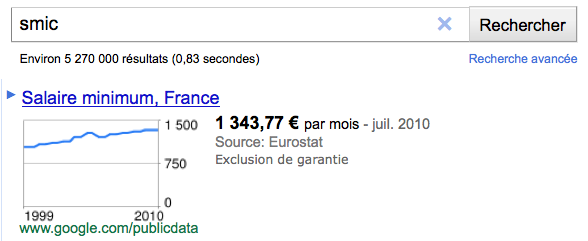
Clicking through, you can interact with the data and create comparisons among countries.
We’re also excited to share that the subset of the World Bank Development Indicators which we launched last November in English on google.com are also now available in search in 34 different languages and domains. Try a search for [人口オーストラリア] (population Australia) on [google.co.jp]. You can also find additional public statistics on a variety of topics in Public Data Explorer.
Eurostat and the World Bank have been making this data available to the public for quite some time and we’re thrilled to work with them to make it more searchable, in multiple languages.
We believe that public data empowers people all around the world to make better informed, data-driven decisions that have positive effects at a personal and societal level. So it will be no surprise that we welcome the discussions taking place around the world at the moment about the potential of public data re-use.
Today and tomorrow, as part of its annual meeting, the World Bank is running a special online debate about the power of public data in international development. And here in Europe, it’s great news that Digital Agenda Commissioner Neelie Kroes also sees a lot of opportunity in public data re-use. She’s currently holding a consultation on the PSI directive (first adopted in 2003) and you can share your views with the Commission until 30th November.
Posted by Mary Himinkool, Public Data Partnerships
Kamis, 17 Juni 2010
The UK’s public data tsunami gathers speed
When the British Government said at the beginning of May that they would be releasing a ‘tsunami of public data’ you had to wonder whether reality would match up to the rhetoric. Oh ye of little faith... A fortnight ago, the Government released hundreds of new datasets - including a full list of Government expenditure - and this week, Transport for London announced that they too would be releasing lots of their transport data for free to the public.
The policy itself is not new. It was kicked off in the UK back in 2009 by Sir Tim Berners Lee and has resulted in the establishment of the data.gov site as the primary place for public data to be accessed. But the new Government has sent some strong signals from the top that it is an even greater priority for them to get government departments and agencies to shift from being information hoarders to information sharers.
This new mood makes it a really exciting time for the data geeks amongst us in the UK. It’s clear that the new British Government is getting as excited about data as the developer community itself, and that it is determined to be a European - and perhaps even global - leader in transparency. Countries around the world are waking up to the huge potential for re-use of data financed by the taxpayer. There are good social and democratic arguments behind this policy - but it also makes economic sense. If Governments want to stimulate the national growth of their local Internet economy, making data public for developers to reuse is a great way to build skills and position the country for data based business models of the future.
But, as we all know, the usability of the data is just as important as the data itself. To the ordinary citizen, a gargantuan list of numbers means nothing. Data only becomes useful when it is rendered accessible to the citizen: the task traditionally of statisticians and, increasingly, creative web developers who ‘mash’ different data sets, drop them into data crunching tools and turn them into citizen friendly applications. From Tube schedules to postcode databases, information works best when it can be overlaid with other datasets and correlations can be made, as services such as those created by the Government’s new Transparency Advisor, Tom Steinberg.
Some departments and agencies have been better than others at releasing data in truly useful ways. A machine readable format rather than in a PDF is preferable - so that developers spend as little time as possible manually reformatting and more time innovating. And there should be as few ‘strings’ attached as possible so developers can easily reuse it, mash it up, and create new tools and services. These details matter - and the next step for the UK officials behind the public data agenda is to ensure that all data released has consistently high standards of usability.
We hope this is the start of something big and that, rather than a one-off tidal wave, this becomes an ever flowing river of information that is released.
Posted by Sarah Hunter, UK Policy Manager.
The policy itself is not new. It was kicked off in the UK back in 2009 by Sir Tim Berners Lee and has resulted in the establishment of the data.gov site as the primary place for public data to be accessed. But the new Government has sent some strong signals from the top that it is an even greater priority for them to get government departments and agencies to shift from being information hoarders to information sharers.
This new mood makes it a really exciting time for the data geeks amongst us in the UK. It’s clear that the new British Government is getting as excited about data as the developer community itself, and that it is determined to be a European - and perhaps even global - leader in transparency. Countries around the world are waking up to the huge potential for re-use of data financed by the taxpayer. There are good social and democratic arguments behind this policy - but it also makes economic sense. If Governments want to stimulate the national growth of their local Internet economy, making data public for developers to reuse is a great way to build skills and position the country for data based business models of the future.
But, as we all know, the usability of the data is just as important as the data itself. To the ordinary citizen, a gargantuan list of numbers means nothing. Data only becomes useful when it is rendered accessible to the citizen: the task traditionally of statisticians and, increasingly, creative web developers who ‘mash’ different data sets, drop them into data crunching tools and turn them into citizen friendly applications. From Tube schedules to postcode databases, information works best when it can be overlaid with other datasets and correlations can be made, as services such as those created by the Government’s new Transparency Advisor, Tom Steinberg.
Some departments and agencies have been better than others at releasing data in truly useful ways. A machine readable format rather than in a PDF is preferable - so that developers spend as little time as possible manually reformatting and more time innovating. And there should be as few ‘strings’ attached as possible so developers can easily reuse it, mash it up, and create new tools and services. These details matter - and the next step for the UK officials behind the public data agenda is to ensure that all data released has consistently high standards of usability.
We hope this is the start of something big and that, rather than a one-off tidal wave, this becomes an ever flowing river of information that is released.
Posted by Sarah Hunter, UK Policy Manager.
Langganan:
Postingan (Atom)